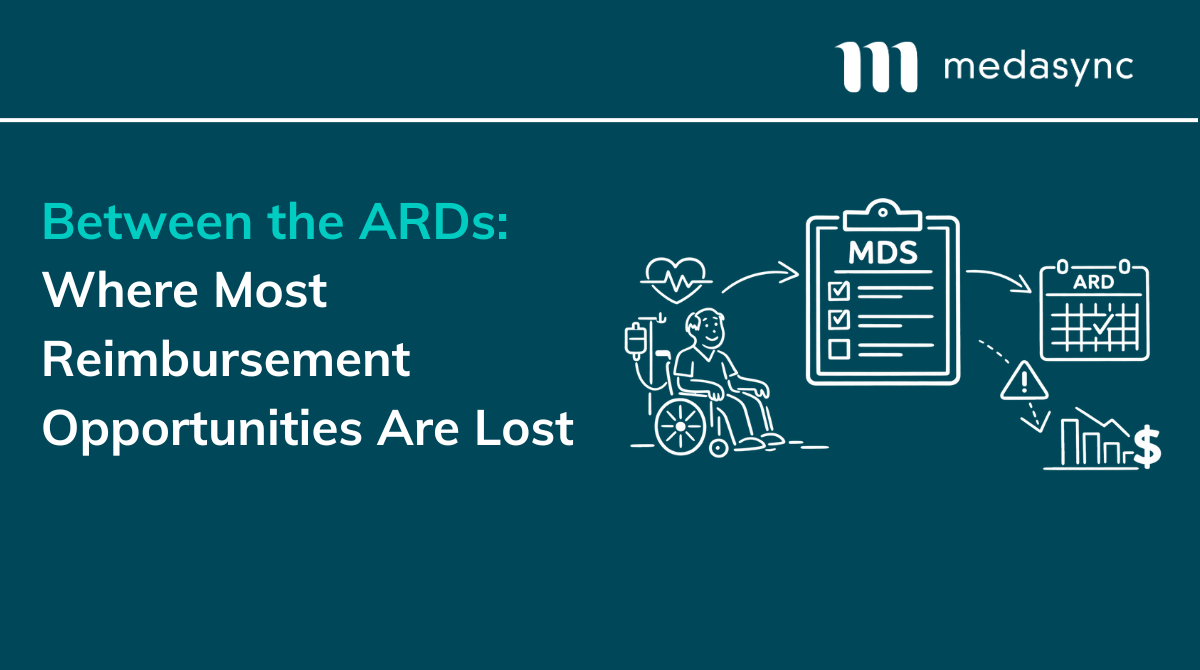
Between the ARDs: Where Skilled Nursing Reimbursement Is Actually Lost
Why Strength on Assessment Days Is Not Enough
If you ask an MDS or reimbursement leader where their process performs best, the answer is usually assessment days. ARDs are structured, scheduled, and receive focused attention. Most organizations execute them well.
The challenge is not assessment days. The challenge is everything that happens in between.
Resident condition and functional status do not follow the MDS calendar. Meaningful clinical and functional changes often occur days or weeks before the next scheduled assessment. When those changes go unnoticed, real reimbursement opportunities quietly slip away.
This is not a theoretical problem. Skilled Nursing organizations consistently report that their biggest revenue gaps come from missed changes between assessments, not from poorly executed ARDs.
The Limits of Point in Time Reimbursement Review
Many Skilled Nursing organizations still manage reimbursement through a series of checkpoints. Teams prepare carefully for scheduled assessments and rely on manual chart review and individual vigilance to identify changes between ARDs.
As reimbursement complexity grows across PDPM, Medicaid CMI, Medicare Advantage, and Quality Incentive Programs, this approach becomes harder to sustain. Documentation is spread across nursing, therapy, and providers, while MDS and reimbursement teams remain lean. Even in strong organizations, it is unrealistic to expect staff to consistently catch every subtle clinical or functional change through manual review alone.
When those changes go unrecognized for days or weeks, the financial impact compounds. Small misses add up quickly, especially across multi-facility organizations.
The Visibility Gap Between Assessments
Resident status is constantly evolving. Changes in functional ability, clinical acuity, therapy intensity, and care needs can occur at any point during a stay. These changes are documented daily, but the documentation lives across nursing notes, therapy records, and provider updates.
In theory, all of it should be reviewed. In practice, time constraints make that impossible. Important signals get buried in routine documentation, creating a visibility gap between ARDs where reimbursement risk and opportunity often live.
For many organizations, this gap is the difference between feeling confident in reimbursement performance and constantly wondering what may have been missed.
Why Manual Review Falls Short, Even for High Performing Teams
Most teams try to close this gap by reviewing more charts. The effort is real, but the approach has limits.
At Windsor House, regional reimbursement leaders spent hours each day reviewing documentation across multiple communities. Despite the time invested, it was still difficult to feel confident that all reimbursement impacting changes were being identified consistently. The issue was not dedication or expertise. It was simply that manual review could not keep pace with continuous clinical and functional change across buildings.
This experience is common. Point in time processes are being asked to manage a continuous problem.
Moving Toward Continuous Oversight
Leading organizations are beginning to rethink how reimbursement oversight works. The question is shifting from “Did we catch everything at the ARD?” to “Do we understand what is changing today?”
Answering that question requires continuous visibility into daily documentation and a way to focus attention only on changes that truly matter for reimbursement and quality, without adding more administrative burden.
How Technology Is Closing the Gap
Effective reimbursement oversight requires more than keyword searches or generic alerts. It requires payer specific intelligence that understands how Medicare, Medicaid, Medicare Advantage, and quality programs actually reimburse.
MedaSync provides this visibility by continuously monitoring daily clinical and functional documentation and interpreting it through payer-aware AI agents built specifically for Skilled Nursing. Instead of relying on staff to hunt for changes after the fact, MedaSync surfaces high confidence reimbursement and quality insights as they emerge between ARDs, across payers, and across facilities.
This approach has delivered measurable results. Lionstone Healthcare reported capturing an additional seventy-two dollars per day in Medicare reimbursement from previously missed IPA opportunities and up to one hundred thirty-nine dollars per day in Medicare Advantage reimbursement through better level of care alignment. They also achieved a nearly one-point increase in average Medicaid CMI while saving more than six hundred eighty hours annually in manual chart review across their portfolio.
Just as important, leaders reported increased confidence walking into audits, stronger interdisciplinary alignment, and less reactive cleanup at the end of the stay.
The Impact of Better Visibility Between ARDs
When organizations gain visibility between ARDs, the impact is immediate. Teams spend far less time reviewing charts and far more time acting on meaningful changes. Reimbursement opportunities tied to real clinical change are captured earlier and more defensibly.
Reimbursement is not a single moment in time. It is an ongoing process. Organizations that perform best are not simply doubling down on assessment days. They stay connected to what is happening between them, where the most meaningful opportunities often exist.
Adopting a Continuous Reimbursement Strategy
If your team feels confident on assessment days but uneasy about what happens between them, it may be time to rethink how reimbursement oversight is managed.
A continuous, payer aware approach allows Skilled Nursing organizations to stay aligned with resident change, reduce manual work, and protect revenue integrity without compromising care quality.
Learn how MedaSync helps Skilled Nursing teams maintain continuous visibility between ARDs and capture appropriate reimbursement across PDPM, Medicaid CMI, Medicare Advantage, and Quality Incentive Programs.