Solving Healthcare Reimbursement Visibility Across States and Payers
If you operate across multiple states and multiple payers, you already know that reimbursement is not just complex, it is constantly shifting. Every state has its own nuances, Medicaid reimbursement complexity varies widely, managed care introduces another layer of variability, and Medicare operates with its own structure entirely. None of these systems are static, and the expectations tied to each one continue to evolve. For most organizations, the challenge is not simply understanding these differences. It is maintaining true healthcare reimbursement visibility while trying to run an operation that depends on getting it right every single day. And in that environment, the biggest risk is rarely the complexity itself. It is what gets missed inside of it.
As Lisa Sinatra, Sr. Director of Clinical Reimbursement at Ciena Healthcare, put it, “When you operate across multiple states and across all payers, reimbursement complexity is a given. Every state has nuances, and Medicare, Medicaid, and Managed Care all have their own expectations. MedaSync brings clarity to payer complexity and gives us confidence that nothing is slipping through the cracks.” That reality is not surprising to anyone in the industry. Multi state reimbursement challenges have always existed, but what is more difficult now is maintaining confidence as those challenges scale across buildings, teams, and payer environments. The systems and processes that work in one location often start to break down when applied more broadly, and gaps begin to emerge in ways that are not always immediately visible.
Most providers have already built processes to deal with payer complexity in healthcare. They have strong teams, established workflows, and systems designed to manage reimbursement across Medicare, Medicaid, and managed care. On paper, it often looks like everything is accounted for. You can see your census, your payer mix, your authorizations, and your billing status. But even in well run organizations, there is often a gap between what is visible at a high level and what is actually happening at the resident level. That gap is where risk lives. It is where small changes go unnoticed, where documentation does not fully reflect clinical reality, and where opportunities to capture appropriate reimbursement quietly slip by without anyone realizing it until it is too late.
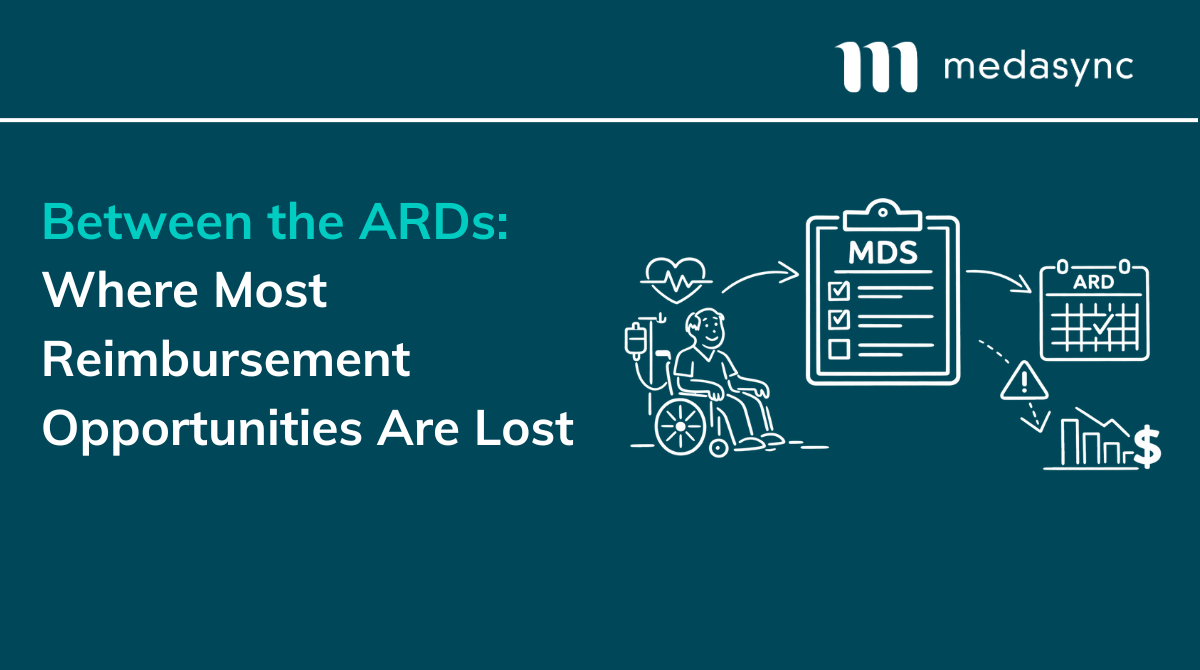
One of the clearest examples of this is functional decline. Clinical teams are constantly monitoring residents and responding to changes in condition, which is the foundation of good care. But from a reimbursement perspective, consistently identifying, tracking, and capturing functional decline across multiple buildings, states, and payer environments is far more difficult than it sounds. Functional decline reimbursement impact is not always immediately visible, especially in fragmented systems. It requires more than awareness. It requires a level of healthcare reimbursement visibility that connects those clinical changes directly to financial outcomes in real time. Without that connection, organizations are often left in a reactive position, trying to piece together what happened after the fact rather than acting on it when it mattered most.
That shift from reactive to proactive reimbursement management is something we hear about frequently from partners. As one leader shared, “What really stands out is how MedaSync helps us stay proactive. We are not waiting for problems to show up on a report weeks later. MedaSync gives us the visibility to see trends early, support our teams in real time, and protect performance before issues escalate. That shift from reactive to proactive has made a meaningful difference.” It is a simple idea, but a powerful one. When teams have real visibility into reimbursement trends and risks, they are no longer chasing issues after the fact. They are managing performance in real time.
The reality is that most traditional approaches to post-acute revenue cycle visibility were never designed to support this level of insight. They are built to process what has already been documented, not to surface what should be happening next. Spreadsheets, reports, and manual audits can help identify known issues, but they rely heavily on human intervention and tend to focus on what is already visible. They are far less effective at uncovering what is not. As organizations grow and operate across more complex managed care reimbursement environments, this limitation becomes more pronounced, and what once felt manageable becomes increasingly difficult to sustain.
This is where visibility fundamentally changes the equation. Not just visibility into high level metrics, but into the specific moments that actually drive reimbursement outcomes. Being able to clearly see where functional decline is occurring, which residents represent potential reimbursement opportunities, and where there is risk that something is being missed allows teams to operate in a completely different way. Instead of constantly reacting, they can prioritize, focus, and act with confidence. Or, as another partner put it, “The oversight and visibility we get from MedaSync allow us to stay ahead instead of reacting later. That peace of mind is incredibly valuable.”
At MedaSync, this is exactly the problem we set out to solve. Not just managing reimbursement workflows, but bringing clarity to payer complexity in a way that reflects how reimbursement actually works in practice. That means going beyond surface level visibility and into the details that matter most. It also means addressing a gap that has largely gone unaddressed in the market. We are the only solution today that actively tracks functional decline and connects it directly to reimbursement opportunity. In an environment where so much depends on capturing the full picture of a resident’s condition, that level of insight is not just helpful, it is essential.
Reimbursement is not getting simpler. If anything, it is becoming more fragmented, with more variation across states, payers, and programs. The organizations that succeed in this environment are not the ones trying to outwork the complexity. They are the ones that invest in healthcare reimbursement visibility and use it to navigate payer complexity with confidence. They move from reactive to proactive reimbursement management, from uncertainty to control, and from disconnected data to clear, actionable insight. Because at the end of the day, the difference is not how complex the system is. It is whether or not you can actually see what matters inside of it.
If you are operating across multiple states and want a clearer view into where reimbursement risk and opportunity exist, it may be worth seeing how MedaSync works in practice.