

Spot Quality Risks Before They Hit the MDS
Payer-aware AI that identifies functional decline and triggering events early so teams can intervene before quality performance is impacted.

Quality Incentive Programs Depend On Early Action
Quality Incentive Programs only work when functional or clinical changes are caught early enough for teams to act. But in reality functional decline is often discovered at MDS time when it’s already too late.
Even when your team delivers excellent care, Medicare Advantage variability creates risk, denials, and missed opportunities.
QIP-Sync changes the timing.
Using payer-aware AI QIP-Sync continuously reviews documentation to detect early functional decline shifts in mobility or ADLs and triggering events that influence QIP scoring and outcomes.
Teams get visibility early not after the fact.
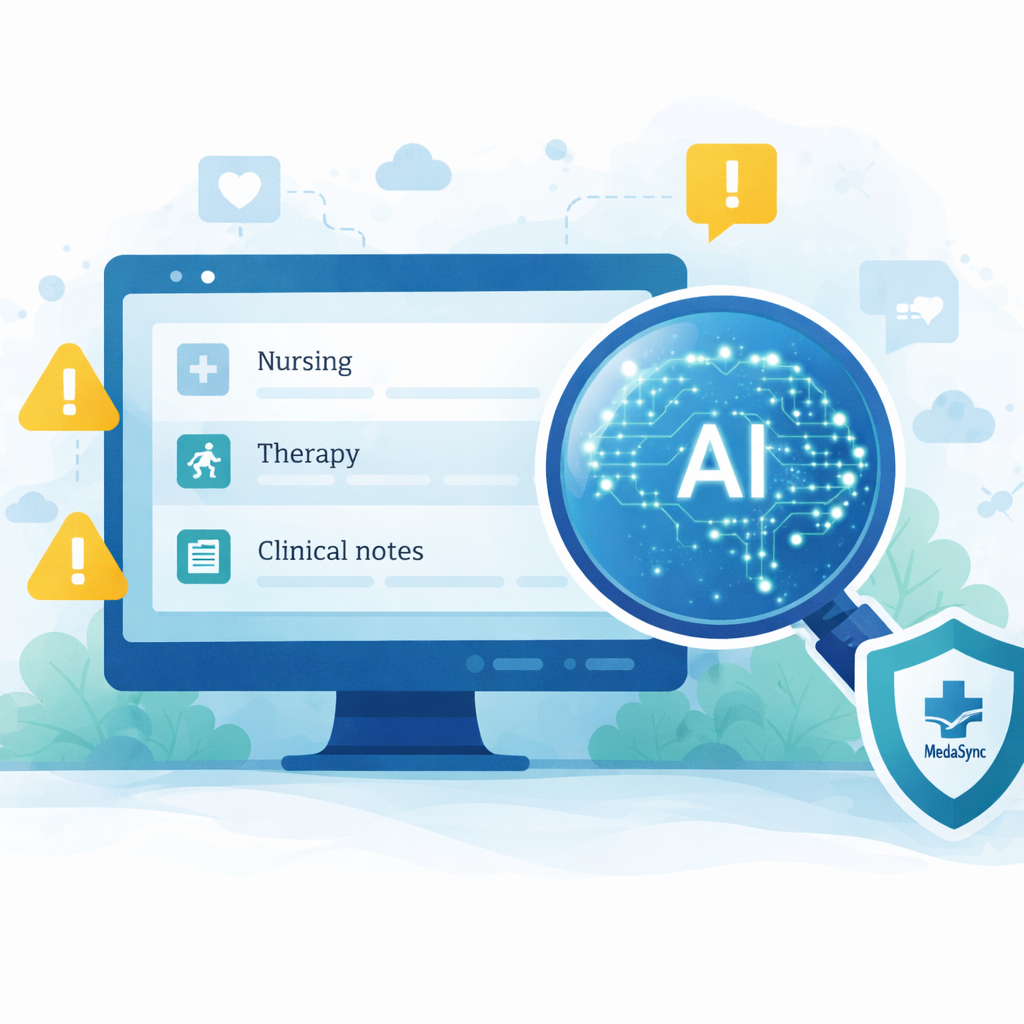
Why QIP performance breaks in skilled nursing
Quality outcomes suffer when:
These are timing issues not staffing issues.
QIP-Sync fixes the timing.
How QIP-Sync Works
Designed to surface functional and clinical risk before it impacts quality scores.
Real-Time Functional Decline Detection
Identifies early changes in mobility ADLs cognition and safety long before the MDS.
AI-Driven Documentation Monitoring
Continuously reviews nursing therapy and assessment documentation to surface meaningful change.
Interdisciplinary Alignment
Flags inconsistencies between therapy and nursing documentation that impact quality outcomes.
The QIP-Sync Advantage
Customer Success
“It gives our staff back several hours each week.”
Leslie Piper
Director of Clinical Reimbursement, TLC Management
“It gives us a predictive view we never had before.”
Adam Cusner
CEO, Lionstone Healthcare